
Alternate Professional Learning
Effective professional learning is crucial for teachers to succeed in today’s classrooms. Unfortunately, many current programs are too generic and don’t have continuous support during the most essential times. This can leave teachers feeling unsupported. For this reason, I have developed a plan to change our approach in order to implement my innovation plan for blended learning in the classroom.
Why must we change PL?
Professional learning (PL) must change to better meet the needs of educators and improve student outcomes. Often, teachers find themselves without support during critical moments when they need it most, leaving them feeling isolated and overwhelmed. Additionally, many PL sessions are filled with irrelevant content, focusing on standardized testing or subjects that do not align with the specific needs of all educators. This not only wastes valuable time but also undermines the effectiveness of professional development. You can read more here.
Duarte's Five Key Principles
To ensure the creation of effective professional learning, we will follow Duarte's five key principles. These principles provide a framework that prioritizes relevance, engagement, and practical application, ensuring that our professional development meets the diverse needs of educators. By focusing on clear communication, fostering collaboration, and aligning training with real classroom experiences, we can create a more impactful learning environment. This approach will not only empower teachers but also enhance student outcomes, making our professional learning initiatives more effective and meaningful.


To create a plan for changing professional learning in our school, we first needed to establish a Big Hairy Audacious Goal (BHAG). his goal will guide us as we move through our professional development sessions, helping us ensure that each training aligns with our vision. By keeping this goal in mind, we can stay focused and motivated throughout the year, regularly checking our progress and making adjustments as needed. This approach will help us create a more meaningful and effective professional learning experience for all educators.
Our BHAG is to complete a year of professional learning that embodies the five key principles of effective professional development in order to empower teachers not only to implement the rotational model of blended learning effectively but also to model these practices for their peers.
I have also created a three-column table to help us stay focused on learner outcomes and develop truly effective assignments aligned with our BHAG. This table will allow us to clearly outline the specific learner outcomes we aim to achieve, and the assignments that will support those goals. By organizing our efforts in this way, we can ensure that every activity is purposeful and contributes directly to our overall mission for professional learning.
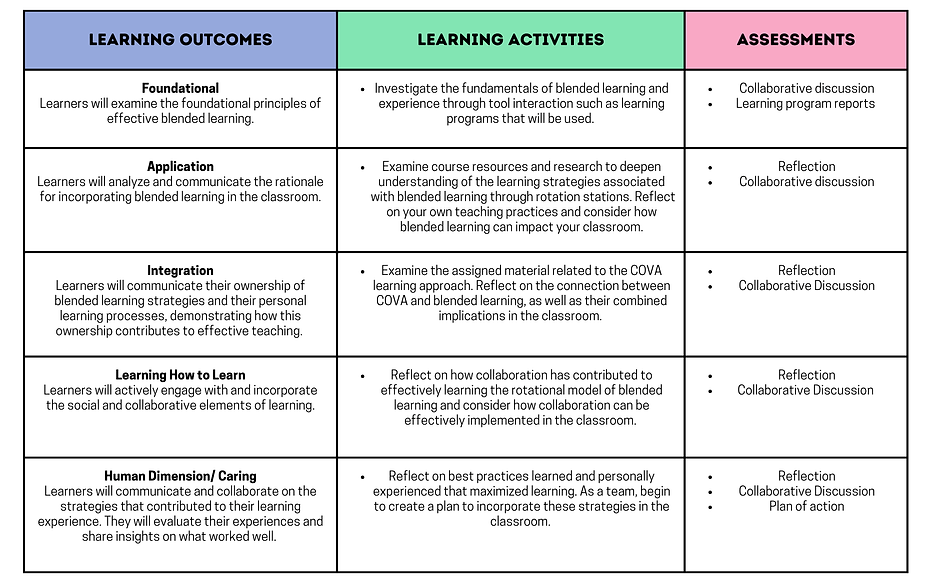

As part of my plan to transform professional learning in my school, I have created an outline that includes all the essential components needed for the success of this initiative. To view the full outline click here:
Audience and Their Needs
The audience for this professional learning initiative consists of one grade-level team of teachers who will focus on learning and implementing the rotational model of blended learning in their classrooms. Additionally, administrators will be involved in this initiative to gain insights that will enable them to support the team effectively when it comes time to expand to other grade levels. Together, they will also explore the COVA learning approach, understanding how the integration of both will enhance the effectiveness of their teaching and student learning.
Who will lead?
The leaders for this initial implementation of blended learning this year will be myself and an administrative member with experience in blended learning. I will lead the first few professional development sessions before we fully transition into collaborative efforts. By the end of the year, the entire team will step into leadership roles for this initiative, equipped with the experience needed to guide future implementations to other grade levels.
Fostering Collaboration
To foster collaboration in this initiative, I will create a supportive environment where teachers feel empowered to share their experiences insights. Regular meetings will be held to encourage open dialogue, allowing everyone to discuss challenges and successes. Additionally, I will facilitate peer observation opportunities, where teachers can learn from one another. By valuing each teacher’s input and fostering a sense of shared ownership, we can create a culture of collaboration that enhances the overall success of the initiative.
Resources
The following resources will be essential to enable teachers to learn the rotational model of blended learning:
-
Laptops
-
Smartboards/Clever boards
-
Wifi
-
3 Column Chart
-
Access to online programs
-
Innovation Plan
-
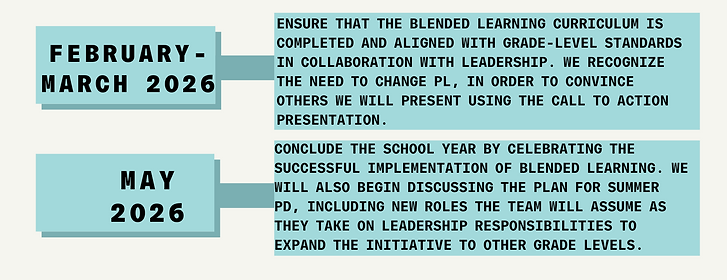
I have also created a timeline for the 2025-2026 school year that outlines how we will meet regularly and ensure ongoing support, modeling, and engagement throughout the year. This timeline will help us stay organized and accountable, allowing us to track our progress and make adjustments as needed to foster a collaborative learning environment.
Professional Learning Outline
Big Hairy Audacious Goal
References
Goodwin, B. (2015). Research Says/Does Teacher Collaboration Promote Teacher Growth? Educational Leadership, 73(4), 82–83. Retrieved from http://www.ascd.org/publications/educational-leadership/dec15/vol73/num04/Does-Teacher-Collaboration-Promote-Teacher-Growth%C2%A2.aspx
Gulamhussein, A. (2013). Teaching the Teachers Effective Professional Development in an Era of High Stakes Accountability. Center for Public Education. Retrieved from
http://www.centerforpubliceducation.org/system/files/2013-176_ProfessionalDevlopment.pdf
Harapnuik, D. (2021). COVA. Harapnuik.org. https://www.harapnuik.org/?page_id=6991
TNTP. (2015). The Mirage: Confronting the Hard Truth About Our Quest for Teacher Development. Retrieved from http://tntp.org/publications/view/evaluation-and-development/the-mirage-confronting-the-truth-about-our-quest-for-teacher-development